Showing posts with label Sigmosaics. Show all posts

11/02/2010

Tuesday tools of trade

This tuesday we are headed to St Louis, Missouri to meet Mark from Holzfurhaus . Holzfurhaus was created as a creative outlet, a means to learn, nurture, generate and share a vision from within. Mark specializes in unique, one of a kind, artistic turned items and he's giving us an indepth overview of the tools he uses to create these wooden works of art.


Mark, can you please take us through the tools that you use in your creative process?


The most important tool is sketching. I do tons of sketching. Then I completely leave the sketch behind and go to the freedom of the shop. The above sketch is one of the rare sketches I tape up on the shop wall. This one is here because I have started doing Christmas ornaments. I have done six ornaments and I only see two of them on this piece of paper. So it is really just a loose guide or a subliminal suggestion.


Chainsaw is used to get the wood from the log to the lathe. I have two. I discovered it was much easier to use an electric chainsaw for one cut rather than spending a day's worth of energy pull starting the gas powered one. With a natural edge bowl, the chainsaw can become the most creative tool I use. My patio is now one big pile of wood.


Band saw is vital in trimming the chunk of wood down to get it balanced for turning. If the piece of wood is not balanced when it is attached to the lathe, the lathe will vibrate, walk across the shop floor then throw the chunk of wood at you. I laughed when I read that somewhere. Then as I progressed into larger more experimental pieces it all came true.


Lathe is where all the time is spent and all the creativity comes to fruition. The lathe turns the wood. I cut away leaving the final product. The piece is shaped, sanded and finished right on the lathe. The lathe tools become the artist brushes. In the background you can see my high tech ventilation system. Just blow the dust away from me.


Grinder is vital because the tools have to be sharp and it is an ongoing, continuous process.


Lathe tools are really just a variety of sharp edges to put against the turning wood. Did I say sharp? I bought 3 sets and modify them to my liking.


What sort of monetary outlay have you had in setting yourself up with the equipment that you have?

My shop was set up for the occasional saturday woodworking project. The tools were accumulated over years of birthdays, Christmases and tax returns. So basically everything I start out to do immediately exceeds the limits of my equipment. I would like to thank my equipment at this point for putting up with me and the abuse I put you through. Total expenditure would be under $2000. I recommend not eating for 4 years or selling your first born and spending about 4 times that amount. That way all the equipment can be the all important, same color.


What special care and/or cleaning is required to keep your tools in optimal working order?

Other than the occasional cleaning from all the dust, most of the equipment requires little maintenance. Special care has to be taken in keeping the lathe tool cutting blades sharp. In the beginning I developed what I call "Turner's Elbow". This is agonizing, continuous pain, caused by bizarre angles with the arm, undue pressure and unnatural vibration. Then I did a little research and found this elbow ailment was common among wood turners. What do you do to fix it? Sharpen your tools. I do that. No, sharpen them all the time. I do that. No, I mean all the time. So I moved the grinder (sharpener) even closer and started doing it subconsciously, almost constantly and the elbow pain, eventually, miraculously went away.


What sort of safety equipment do you need to wear when you are creating your items?

With all the shop equipment, eye protection is very important. Here is where I am lucky. I got glasses when I was in the 5th grade. All that ridicule at an early age has finally paid off. My eye protection is always on. The helmet and full body armor is no longer needed. It has been replaced by experience, common sense and a stand to one side approach. I just told someone recently that I can actually hear bad things approaching. When hollowing out the inside of a bowl it will sometimes crack or I will be carving too deep, there will actually be a different sound in the cutting.


If you could own any kind of tools that aren't related to your own craft what would they be?

There are times when I wish I was a potter, with a wheel and a kiln. Like when a large bowl cracks or loses a side and the bowl immediately becomes a very small plate. I would love to be able to just add more material back on and continue working. Then of course I realize most of the beauty in my work comes from the wood telling me what to do. I don't have this kind of relationship with clay. Exhaulted Spalted II Decorative Vessel

10/27/2010

Tuesday tools of trade

This weeks tools of trade interview takes us to the hamlet of Sayville, Long Island, New York ... Sayville was founded by a man named John Edwards who built his first home there in 1761, the hamlet was accidently named 'Sayville' (it was meant to be called 'Seaville'), when the error was discovered the people wrote a letter to Washington to have it spelt correctly, that request was turned down as it was felt there were too many 'Seaville's' in the world and that 'Sayville' was unique ... speaking of unique, the very talented ceramic artist, Jill from GlazedOver is here (in Sayville) to give us an insight into the tools she uses to create her rustic and vibrant ceramics and indie jewelry. So, without further ado - let's go!


Wabi sabi nesting bowls pumpkin and blue handmade


Would you take us through the tools you use in your creative process?

I'm very grateful to say that now my creative process begins with my beloved pugger.


Instead of me wedging the clay manually (at the costs of my wrists), the pugger processes all of my recycled clay mixing dry with moist flawlessly and then de-airing the lot. Thanks to my pugger I can now spend my time more productively and more creatively.

There are so many ways to work clay, but I'm partial to slab built and wheel thrown work. Depending on which whim strikes me (or which custom orders are on the roster), I'll head over either to the slab roller or to the pottery wheel and the process takes off from there.


There are various small tools - like pin tools, ribbon tools, sponges, ribs, calipers, and wire tools - that are appropriate to each method and sometimes even unexpected things can be useful tools. Lace, a corn cob, a shell, or a barnacle can be used to create texture, for example. The sky's the limit!


When I've finished tweaking a piece, I set it on the drying shelf. Once it is 'bone dry' (absolutely, completely and utterly devoid of all moisture) it goes into the kiln for the bisque firing. After it comes out, I glaze it and put it back into the kiln for the glaze firing.


Often, people don't realize how time intensive clay work is. From start to finish, depending on the size and structure of the piece, it can be upwards of 3-4 weeks before the bisque firing is even appropriate.


Can you give us some sort of indication on the monetary outlay you've had in setting yourself up with the equipment that you have?

From the kiln to the wheel to the pugger to the tools ... ugh. Clay equipment is very expensive. Not including electric hook up, shelving and supplies, I've spent upwards of $10,000 on equipment over the years.


What special care and/or cleaning is required to keep your tools in optimal working order?

Well, clay dust is a biggie. Left unchecked, it can have serious effects on one's health. Other than carefully washing clay off of my tools and wheel after use, I regularly vacuum and wet mop the studio. I keep my studio as clean as I can. On a practical level, it is nice to start each day's work on a clean surface. And now that I am teaching children's classes there, it is absolutely necessary for the studio to be in top shape at all times.
Other than that, there is no real equipment upkeep except for making sure that all parts (especially kiln elements and bricks) are in working order.


Do you need to wear any kind of safety equipment when creating your items?

For mixing glaze ingredients or using kiln wash (which contain toxic elements), I wear a dual cartridge mask. For viewing progress during firing I wear heat resistant gloves and dark goggles (which also help me look really cool!).


If you could own any kind of tools that aren't related to your own craft what would they be?

I think I would want to own a lathe for metal work. Metal strikes me as a material that is akin to clay in as much as it can be negotiated into any shape. It needs a different kind of coaxing, but the creative thought process necessary for metal work seems compatible with the way my brain works.

Other than that, perhaps a money printing machine with 20 dollar plates. And oh yes, that special cotton paper that goes with it. That should do me.


(Notice my studio manager by the ceiling at the top right corner)


10/12/2010

Tuesday tools of trade

Austria is famous for it's spectacular scenic beauty, you may well remember Maria running solo and with the children through the alpines in 'The Sound of Music' ... It's also the birthplace of Daniel Swarovski (he founded the Swarovski Crystal empire) and of course it's where 'Hasta la vista baby' Arnold Schwarzenegger hails from. There's another amazing (and super talented) Austrian I'm excited to introduce you to today, it's Renate of Kreativlink and we are headed there now to gain some insight into the tools she uses to create her incredible handmade journals (of which I own one or two and can certainly vouch for their beauty & awesomeness!) .. and if we are really very nice, i'm sure she might even treat us to some famous Austrian Kaiserschmarrn (soft fluffy pancakes - yum!) ...

Would you take us through the tools you use in your creative process?

Very few tools are needed for my bookbinding. Always on my desk is the bone folder for folding paper, an awk to make holes, a little hammer for when I punch holes into leather (though hubby says it's so tiny it's a toy and not a tool), scissors, pliers for when the needle is stuck somewhere, needles, linen thread and beeswax because I don't like pre-waxed thread.


My sewing machine (aka 'The Diva') is another important tool. I'd love to have a super strong industrial one but this was the best I could afford three years ago and well, so far she does her job well - apart from when she's having a 'bad hair day' ...

'The Diva'

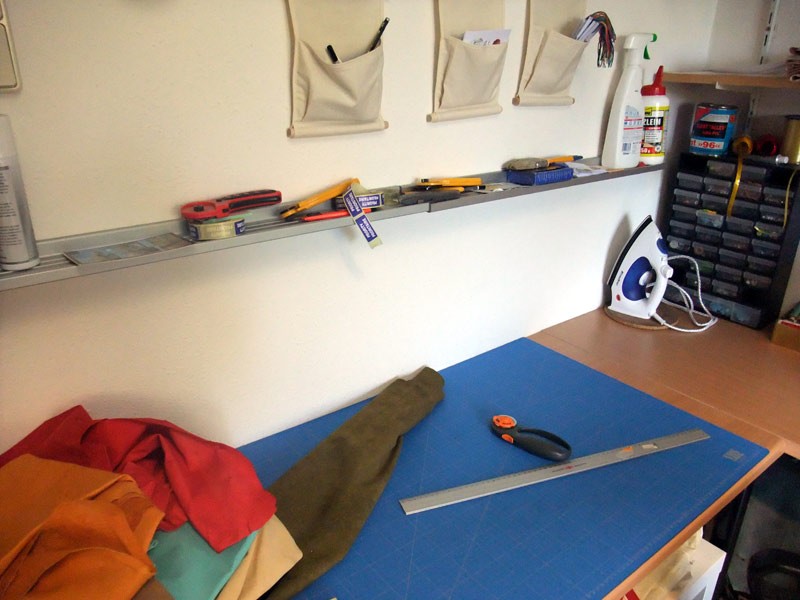
Also needed is a big cutting mat, ruler and rotary cutter for cutting leather and fabrics.

Lastly, there's the painting corner with lots of fabric paints, brushes and all those sorts of things. A very important tool here is the blow-dryer. I'm not one to wait patiently until the paint is dry! :D


But wait - very importantly (although technically not a tool), is the TV opposite my desk. I'd go crazy if I had to do boring things like tearing paper, sewing in thread ends and such without having it (the tv) to keep me entertained.


What sort of monetary outlay have you had in setting yourself up with the equipment that you have?

Most of my tools are very affordable or were in the household anyway. The sewing machine was EUR 700 three years ago and the biggest investment so far.

What special care and/or cleaning is required to keep your tools running smoothly?

The Diva needs some hugs on her bad days. Apart from that nothing needs any special care.

Is there any special safety requirements for when you are making your journals?

No. Well, not really. But only because I don't mind ink stains and paint drops on my clothes ...

Renate, if you could own any kind of tools that aren't related to your own craft what would they be?

I'd love to have everything needed for making pottery. A pottery wheel, yes! Of course, I have no idea how to work with it as I have never tried it before, but I imagine it is a very sensual and wonderful (and in my case very messy) experience.

9/28/2010

Tuesday tools of trade

Hot on the heels of Fall we are headed back to the northern hemisphere to meet up with the lovely Renee from decoratethediva in Canton, Ohio, US, where she's taking us through the tools of her trade. Renee makes beautiful and unique jewelry ranging from eco friendly & nature pieces through to modern, retro & romantic vintage works of art. Better whisk out your scarf though, I hear those northern nights are getting cooler this time of year ...


Renee, would you take us through the tools you use in your creative process?

When I create a piece of jewelry I want it to be a keepsake, so I use quality materials that will last. My choice for tools should be no less. To start, my basic hand tools are the flat nose pliers, the bent nose pliers, the round nose pliers, and several pairs of good wire cutters. I could not do my work without them - of course, ergonomics is important so I find tools that fit me and work easily.


I use flat bead containers to store my beads and have them organized on shelves for easy access and clear labels that help me save time as I search for that perfect piece to bring each project together.


I set my work area in a way that once I am inspired I can work for long hours. I have a good comfortable desk chair that swivels from my computer to my work table and lighting is very important. I prefer the natural light from my big window.

My work area is kept clean and tidy by using little cups that I have collected over the years and my tools are in a rotating caddy organizer.


Once I've created my masterpiece, I have a work area for photography. When you sell over the internet you must appeal to the eye. A decent camera and lighting help to bring out the beauty in your artwork, enhancing details and eliminating shadows. Sometimes you have only seconds to convince someone to stay in your shop, I think clear professional looking photos have that power.

As far as materials go, I prefer sterling silver, copper, brass, gold fill, wire and chain to make most of my jewelry. I use soft touch stainless steel cable for my necklaces and nice sturdy toggles. I've hunted high and low for good quality stones, glass and vintage materials. Sourcing for my materials comes from online, local bead shops and bead shows. I have also put many hours into studying gemology so I know what I am looking for in quality and can recognize my stones when I purchase them.


Are you able to give us some sort of indication on the monetary outlay you've had in setting yourself up with the equipment that you have?

I took over our fourth bedroom and made it into my office. I've been collecting beads for many years. To put a number on it at this point would be hard. I will tell you at first you have a lot of money out of pocket, and then you start to turn the corner of self sufficiency. I have several thousands in beads and findings in my office right now. There's also my photography equipment, laptop, printer, packing supplies, a desk and tables to add onto the amount. It can get pretty pricey selling jewelry because the materials and tools are expensive.


Is there much care and/or cleaning required to keep your tools in optimal working order?

I'm a very clean person and like to clean all my beads before touching them, it makes more work for me but i'd rather sell clean items. I use hand santitizer constantly. It's important to me that anything I touch will be germ free for the person who wears it. I'm sensitive to dust and grime on my skin and treat all my customers as if they are also. As far as cleaning my tools there is no need to because I have clean hands. Keeping my cutters sharp is important. I can't really sharpen them so buying new ones every year is my only choice.


Is it necessary to wear any kind of safety equipment when creating your jewelry?

Nope ... it's not necessary but wearing my glasses protects my eyes from metal clippings when I cut the excess after wire wrapping a stone or glass.

This last question is really one for 'wishing' and it's fun to ask it ... If you could own any kind of tools that aren't related to your own craft what would they be?

I'd love to own my own pottery wheel and kiln to make pottery.

Black Onyx and Red Glass Hearts Necklace

9/21/2010

Tuesday tools of trade

This week i'm jumping into a rather large canoe to paddle across the Tasman sea to meet up with Belinda from gretchenmist who resides in Melbourne, Australia. She's sharing with us the tools she uses to create her incredible original artwork. For those of you on the other side of the world, make sure your seatbelts are fastened as the jumbo is about to take off ...


Belinda, would you take us through the tools you use in your creative process?

I like to work with a variety of mediums ~ partly because I like to try out new materials and also sometimes I have an idea which will only feel right with a particular medium or combination of materials.

I primarily paint with golden acrylics ~ they are so beautiful to use. They have a super high pigment content and lovely texture. I used to paint with oils rather than acrylics, until I discovered these acrylics. They behave a little like oils (without the long drying times) and are just like no other acrylic paints. I've previously found acrylics to be kind of 'clunky' ~ thick and plasticy!


Golden acrylics

I also paint with watercolour and gouache (opaque watercolour). I choose the paints depending on the kind of work i'm doing. If I think I will want to include a top layer of drawing and i'm working on paper, I often use watercolour or gouache as the texture is different and takes the top layers a little better.


Gouache and pencils

I choose between hot-pressed 100% cotton acid-free paper, stretched linen and wood panels. The different surfaces offer specific qualities that I like or need for a piece.

Hot-pressed paper has a smooth surface which I prefer. I like the feel of heavy (300gsm) paper. Paper is also a great medium for adding stitching and pin holes to drawings. I feel like cotton paper and embroidery cotton make a perfect match. The stretched linen that I choose has a rich, smooth texture and is great for painting small, fine detail as the paint glides on. Wood panels have a matted feeling and offer a beautiful natural texture with the grain, that can mostly be seen through the layers of paint. The grain is like working with a bonus element and usually really adds to a landscape piece.

Stretched linen and wood panels


My brush collection is mainly made up of super fine brushes. I go through these pretty frequently. I have a set of drawing pencils which are a new favourite brand. They work really well with my drawing style which involves rubbing back and adding layers to build up richer and softer lines.

I use takeaway food container lids to mix paint. To me they are perfect, especially the clear ones. I can see what colours will look like together by holding the palette next to the work ~ this saves time and paint!

Palettes and brushes

Palettes

I collect a lot of magazines, which I use for making collages.

The final step in my creative process is the mac ~ set up with adobe software which I use to make prints of my work.

Can you give us some sort of indication on the monetary outlay you've had in setting yourself up with the equipment that you have?

I spent around $600 setting up my space: with two desks (one for cutting and another for working), shelves and drawers. The initial outlay for my acrylics and gouache paints was around $300. Things like paper, wood panels, stretched linen, pencils, brushes, printing paper and inks are all ongoing costs and things that I love to shop for!


Is there much care and/or cleaning required to keep your tools in optimal order?

My work space is pretty low maintenance ~ the main things are making sure I clean my brushes before paint dries in them and storing paper properly.


Is it necessary to wear any kind of safety equipment when creating your items?
No, the only real safety concern is keeping the acrylic paints off my skin. A lot of the bottles have cancer warnings on them. I guess i'm lucky that at the moment my work is small and kind of contained ~ I'm not splashing much paint around or sanding back and creating dust.


I guess this is the 'wishing' question really and it's always kind of fun to ask it .. If you could own any kind of tools that aren't related to your own craft what would they be?

I'd love to have a dedicated sewing room with an overlocker ~ I often wish I had more clothes-making skills.

8/30/2010

Tuesday tools of trade

This week we're catching a commuter jet from Rhode Island, New York and heading south to meet Kendra from Greenpost in sunny St Petersburg, Florida. Kendra makes 100% recycled, upcycled and plantable papercrafts for the eco conscious.


I've long admired your creativity in producing such fantastic pieces through the use of unwanted paper. Can you take us through the tools you use in your creative process?

I began making handmade, recycled paper a little over a year ago and am entirely self-taught. Most of the tools in my papermaking studio have been appropriated from my kitchen and from my painting studio. One of the most beautiful things about making handmade paper is that it can actually be made with common items you already have in and around your home. You don't need to spend tons of money to get started and paper itself can be found everywhere and is eagerly awaiting to be recycled and re-used. This is an interesting time to ask me about my tools because I have just moved into a larger studio and am starting to make the transition away from my homemade operation and towards a more professional paper mill.


Tools I use: A tall architectural drafting table, desk, fine-mesh strainers, colander, large plastic tubs, sponges, felts, clothes drying racks, weights, heavy books, hand mixer, pitchers, measuring cups, funnels, plastic squeeze bottles, buckets, paper shredder, drill with mixing blade attachment, moulds and deckles (built them myself out of reclaimed wood), cookie cutters, plastic storage containers of all sizes and shapes, scissors, eyelet setter, hole punch, paper cutter, stamps, rulers, exacto knives, punches, bone folder and templates. I could keep going and going because everything looks like a tool to me!


Which leads me on to ask about the monetary outlay you've had in setting yourself up with all of this equipment. You say a lot of these tools have come from your kitchen but is there something extra you've had to buy?

Being asked what kind of "monetary outlay" I've had in setting myself up is fairly simple to assess ... very little! But, one thing I have spent money on is my extensive cookie cutter collection which I use as shaped deckles for my plantable tags. Because you asked, I had to count ... I have 231 metal cutters plus 1 large alphabet/number set and 1 mini alphabet/number set = approx. $500. I buy multiples in designs that sell well. People request every shape tag under the sun and if there is a cookie cutter to match, I'm game! I never would have thought I would spend so much money on cookie cutters :)


231 cookie cutters!

What special care and/or cleaning is required to keep your tools in optimal working order?

Taking care of my tools is important to me even if I spent little to no money in obtaining them. I think of my studio as though it is a kitchen and clean as I go. I am always wiping up water and rinsing pulp from screens. Standing pulpy water and wet wool felts will begin to smell if ignored. So, I always rinse my wool felts in clean water when I am through with them and hang them to dry. I also strain my papermaking tubs immediately after use and wring out and crumble the pulp onto drying racks to dry and store. Paper is expected to be clean and free from debris, so I am constantly organizing and cleaning in order to deliver the best results possible.

Do you need to wear any kind of safety equipment?

I do not really need any safety equipment, but I think comfortable shoes are a must. I stand at my table for hours at a time and my back and legs can become fatigued. I also think it is important to think about ergonomics and am always analyzing my movements and postures. Doing anything repetitively can lead to injury, so it is important to work in ways that are natural for the body.


If you could own any kind of tools that aren't related to your own craft what would they be?

It's difficult to think of tools I want that aren't related to my own craft because there are ways in which I can bring woodworking, metalworking, painting, printmaking and more into my current work with paper. My husband and I share a studio and we plan to expand our woodworking and metal shop, as well as my papermaking shop. I have worked in almost every medium and plan to continue experimenting and trying new things, But, I would really like to own a printmaking press. I studied printmaking in college and would really like to get back to that craft. I would love to be able to print on my own handmade paper!


8/23/2010

Tuesday tools of trade

This week we are jumping back on the jumbo and headed back to the US to meet up with Suzanne of tannerglass in Cranston, Rhode Island. Suzanne makes unique handblown and handsculpted solid glass creations and we're about to find out about the tools she uses.


Would you take us through the tools that you use in your creative process?

All the tools I use are specific to Glassblowing (in other words, I can't go to the Hardware store when I need a new tool). There are 4 basic hand tools that can be found in any Glass Studio. Tweezers, straight shears, diamond shears, and Jacks. These are hand formed from steel, and are durable enough to withstand continual use with molten glass.


You know the old adage "you need the right tool for the job"? Well, the same is true for Glassblowing. I have 3 Tweezers (various sizes), 3 Jacks (various sizes and shapes) and 2 Shears. Essentially, they all do the same thing, but some are better for particular pieces. It just takes time, and experience to understand which tool is right for the job.

Can you give us some sort of indication on the monetary outlay you've had in setting yourself up with the equipment that you have?

Well, they're expensive! But the good news is they will last a long, long, time if treated properly. My Jacks (I have 3) range from $200-$400. They were all worth the investment, especially my Dino's.

Dino's

I travelled to Venice to purchase them from the maker himself 10 years ago. I wrote a nice blog entry about the experience. I bought my first pair of Jacks, tweezers, and shears over 11 years ago and I continue to use them regularly.

Maintenance of your tools must be ongoing. Is special care and/or cleaning required to keep them in optimal working order?

Glass tools are designed to withstand harsh conditions. Glass is about 2000 degrees when we work with it, so our tools have to be able to handle that type of heat. Our Jacks have to be waxed regularly, so they will work smoothly, and won't stick, or scratch the glass. We use a block of beeswax. A special perk about using the beeswax is the sweet, aroma that it creates around the work area. Other than that, maintenance is pretty minimal (thankfully!!). A green scrub pad goes a long way, and I generally only do this once or twice a year.

What sort of safety equipment is necessary when using your specialty tools? I always think a glass blower needs to be wearing big thick padded gloves ....

Glassblowing is as dangerous as you make it. Yes, it's hot, and I have been burned, and I have been cut. So, safety glasses are a necessity (and an aloe plant nearby is a good thing, too). I get by with some basic sunglasses with UV protection. When our equipment is running at full temperature, it can feel like you're staring at the sun, so eye protection is imperative.

Glory hole

open furnace

Our hand tools get hot, too. Very hot, as a matter of fact. But as long as you KNOW they're hot, you're less likely to touch them when you shouldn't. Other than that, we don't do too much in the way of safety. Contrary to popular belief, we don't need gloves.


If you could own any kind of tools that aren't related to your own craft what would they be?

I would love a wood shop. A nice, big wood shop!