4/16/2012
The Art of Parenting Art
Each artist and crafter comes to Etsy with, at the very least, a wonderfully creative idea.
We are so excited and, at the same time, terrified, to open our “doors” and let the world see what we have to offer. Our precious little “newborn” shop. It’s scary and thrilling all at the same time. It’s overwhelming at the beginning and a steep learning curve. Then, once you are here for little awhile, you can look back at those first awkward months and smile.
One of the first things many do (as I did) is browse the Etsy forums looking for tips and advice. I will never forget one of the first user comments I read on an Etsy forum went something like this: “Well, I’ve done every single thing I am supposed to do to be successful here and still no sales. . . now what Etsy?”
I took, from that, the number one tip I still follow . . . I do not rely on or expect anyone elses advice or help to get me where I want to be! If there are 250,000 sellers on Etsy then there are surely as many pathways to, and definitions of, success. There are factors that work, to a degree, across the board. I’d count professionalism, excellent product photography, genuine warmth, realistic expectations and self-critque, uniqueness, impulse appeal, and a certain degree of Etsy network savvy among them.
At the beginning, with time and so much energy that we are willing to invest online, we are drawn to the community of a place such a Etsy. It’s teams, treasuries. helpful blogs, our social media forays and seeking out good and solid advice. It’s a necessary series of steps we climb to get ourselves going. It feels great to be “connected” in a supportive environment. It gets us noticed and, without that help, we could quickly drown in obscurity.
There are amazing upsides to the community but ultimately, as with many things in life, I believe we do better and become stronger when we are forced to venture out on our own. To invent our own way. As an example, I’d offer the number of parents I have known (my own mother included) who have said, “No book or other mother’s advice could’ve prepared me for what parenting was going to be like.”
I, for the record, see my mother as an absolute hero.
I take their word for it since I decided long ago I was not going to have children. My creative world has always beckoned so deeply and, not to take anything from the reality and immediacy of actual parenting, I’d say that my creative world IS my child. And I treat it as such.
It comes first
I can say that if it needs “fed” I feed it.
If it needs attention, I lavish it.
If it’s having a bad day, I sit with it patiently.
My own learning curve this past year has been greatly expedited with the running of three shops that I curate and create for. Each of them is completely unique and different in their content and I can tell you that anything that has worked for me, sales and marketing wise, in any one of them has not necessarily worked in the other two.
Three different shops.
Three completely different paths.
Three different "kids"
The key, for every seller, is always based in finding one’s own unique path. There are, in this web-crazy age, so many possibilities as to where to invest your time and how to build your own base and customer network. New ideas and outlets are popping up every day it seems.
I learned years ago, as all parents do, that I had to prioritize my time and energy and a lot of things would have to be weeded out of my life to make the room required for my art. The rewards for “going without” are, as I expect they are for any parent, immeasurable and often undefinable to others.
So we come here to the Etsy playground . . . with our “children”, and it’s really nice to see others raising such fine young shops too. I admire many and sometimes I wonder “Now what were they thinking?” about others. But it’s a community with a common thread, hopes and goals. We are all raising our little shops as best we can and it helps to just not feel so alone.
In that regard though, I’d like to share something my Zen teacher would often repeat,
“Anything that you truly love to do will feel lonely.”
If you are or have been a parent I believe you have an advantage. Just treat you art, your craft, your shop as you would/did your child. Give it that same unconditional love and undivided attention. Prioritize it with the same immediacy. You will find success in that.
The time will hopefully come when your Art-baby outgrows the toddler stages. It will begin to get around on it’s own. You’ll need to devote even more energy to follow up and care for it then. You’ll need to decide what is really important for continued success and growth. There is no right or wrong answer . . . but these questions all create an infinite lot of possibilities. Leaving us further out on our solitary paths.
There will be more time required. It’s at this crucial stage that I see a lot of people apologizing for the lack of time they then have to invest here. Lack of time for treasuries or comments. Lack of time for blogs or blitzes. Lack of time for chats or keeping up.
There’s no need. . . you’re an art parent. Not to mention you may also have a significant other. Human or animal kids. Another job. etc etc It should be understood that it all comes first.
It should be understood that everything has a time and place and then it too must pass.
Trust your parental instincts. Love what you do. It’s a long term commitment.
Take pride in, and celebrate, that success along the way.
And if moving down that path to success brings about a feeling of loneliness,well, my Zen teacher had a saying for that too. . .
“It’s just loneliness.”
Oh, %@#%$ ZEN! :)
Do you feel a struggle to find time for everything in your life as your business grows?
Do you feel community has to take a back seat to your individual and shops needs for growth?
Do you feel the commitment to ANY life success requires commitment similar to parenting?
Does your art/craft create an experience of loneliness at times?
I’d love to hear your thoughts on any of these!
And thank you for reading. . .
nicolas
3/12/2012
Telling A Story
Here, in the world of e-commerce, potential customers are more inclined to take their time and peruse a sellers works and creations. Or, as the case may be, many sellers and their work. There is no rush or feeling of a salesperson looking over their shoulder. If they are intrigued by the visual aspect they are likely to dig a little deeper. This, I believe, offers a great opportunity and the more you have for a buyer to discover, the more they can come to feel connected to you despite being in the faceless realm of cyberspace.
And this is where I see many people shortchanging themselves in their presentation.
The buyers I have met, through all of my Etsy shop, art gallery and commercial brick and mortar pursuits almost always comment on the story I offer for every item I create. I have heard it time and again that a poem made someone want my imagery, that the story I provided of an Egyptian Goddess steered them to purchase a gift for themselves and I lost count long ago how many people have written me about the Barry Lopez story I mention in my Etsy profile “Where can I find that?” or “Can you recommend anything else?”
If they are reading that, I know they are likely reading my item descriptions too.
The story we provide can come from many places. If, for example, you make jewelry, you can talk about why you feel drawn to designing it or how you got started with it. You can write about the origins of the stones or beads you use or the inspiration that you had for creating a certain piece.
It doesn’t have to reveal a lot.
It doesn’t have to be poetic or meet a standard set by anyone else.
But it MUST be from within
In the case of an item like my new Miniature Moai Statues I have pictured below, I came at the story from two perspectives. On one hand I shared the way the mystery of the ancient Moai statues affected me as a child and two, I offered a bit of the history behind the large monoliths that inspired these.
In building the description from both angles I feel it allows several opportunities to connect and it lends a bit of personal backdrop to the item. I sold two sets in the first week and both customers wrote to me commenting on the story I had provided. It turns out they both feel very much as I do about them. That made me happy because, while I certainly am here to sell my work, I also want people to know there is a reason behind everything I make. A connection somewhere along the way from within my own life. I believe that has been a large part of why customers have been so willing to share a bit of themselves in return as well as to purchase my work.
The perception we should impart is one of loving what we do and an inkling of why we do it. It doesn't matter how simple or how difficult the craft is. We should express when it is coming from the heart, inspired by nature, culled from our experiences or representative of our surroundings, our travels or our life.
Just remember to pull it from inside yourself.
I believe it matters.
Do you feel storytelling is an important part of your creative work and sales? Do you find it enjoyable to share the inspirations or the details behind what you create? Please share you thoughts with me and with our group! We’d love to hear from you. :)
Thank you for reading. . .
nicolas
Here are links to a few other views on the subject :
Viktoria from Donauluft
Pure Pixie's Blog
One Clay Bead: Storyteller or Boring Seller?
7/21/2011
Are Artists Natural Born Con Artists?
Consider this: According to Ian Leslie, “there is a gushing river of verbal creativity in the normal human mind, from which both artistic invention and lying are drawn. We are born storytellers, spinning narrative out of our experience and imagination, straining against the leash that keeps us tethered to reality.”
As artists and artisans we imagine, we invent, we reinterpret reality. We inarguably use the same skill set as cons. Evidence of the intermarriage of art and con can be found in numerous Etsy shops, and as we are encouraged to tell colorful anecdotes about ourselves to capture buyers, you have to wonder how many profiles are true vs. intentional fabrications.
In my observation, there are two distinctly different paths into the arts, two separate motivations. One is primarily driven by the need for praise, for an audience, for money and status, for beating out one’s competition. The other is a path traveled by those who have discovered the joy of mastery and discovery. Artisans Gallery Team was conceived as an alliance of the latter. When we are functioning at our highest and best, we are able to praise and promote the new works of other artisans because we take joy in discovery whether it is from others’ or our own.
One way to spot a con is that every story they tell glorifies themselves, often denigrating others in the process. Whereas an artist on the second path tells a universal story that reaches for insight, using personal facts as illustrations. When we vet and jury for this team we are looking for that type of commitment to authenticity.
editorial by Lee Wolfe
2/14/2011
handmade: a family tradition to pass down (part 9 in our series on inspiration)
The seeds of creativity seem to be planted often, and early, in people who go on to spend large chunks of their life working with their hands and engaged in artisanal work. Perhaps part of the reason is that what we see as children - what we witness (especially in our parents and primary caregivers) - carries so much weight.
Today, in part 9 of our series on the roots of design, Arnelle from the organic clothing shop PurePixie shares part of her inspiration story. (Photo above, and all those that follow, are from PurePixie).
"As far as I remember I always loved to make things with my hands. At school my favorite classes were drawing and crafts.
Both my parents and grand-parents were very crafty and making things was part of their every day life. When my grandma (a former seamstress) became blind, she was still able to do a lot of sewing just by "looking" with her fingers."
In Arnelle's words: "After she retired, my other grandma was knitting and crocheting all kinds of sweaters for us and my mom was sewing all our clothing. They both taught me as a child how to sew, knit and crochet and as a teen I started sewing my own clothing. I remember how my Mom could alter a basic pattern and sew almost anything trendy out of it. My dad was working mostly with (ferrous) metals - for the most part repurposed. I remember that once for my birthday he made a small wardrobe with handmade hangers to store my doll's clothing. The basement of my parent's house is still packed with perfectly sorted pieces of metal that he may need some day. I also remember spending hours reading my dad's children magazines from the late 40's early 50's. Their graphics are still a great source of inspiration."
"Then I went to college and I was so busy studying and working as a tutor to pay my rent that I forgot all about creativity. It is only when I got the opportunity to do some graphic design as part of one of my jobs that I realized how much I was missing it."
"When my husband and I moved to the US in September 2001, I was without a work visa so could not look for a job and I started to create for good. First I made jewelry and even graduated as a jeweler. My favorite domain was forging. It is so amazing to see how a flat sheet of metal can move and become almost alive and take all kinds of organic shapes when forged. When I had my first child I started to make clothing for him and I still do it now that I have two kids. Their favorite pieces of clothing are all home- and hand - made (and organic or upcycled). My youngest one loves to say proudly: "c'est maman qui a fait!"(Mom made it!)
I learned from my family all the basics and when I was ready to start I was able to immediately jump in. I learned also from them that sometimes you have to try over and over again until you get it right. It can be very frustrating but once you figured it out this is all that matters. Hopefully I'll be able to pass this onto my kids."
1/31/2011
The drive to create... no matter what (part 6 in a series)
In part 6 of our ongoing series on the roots of design, the artist behind OneClayBead, Lee, discusses her drive to create... no matter what.
Such a powerful part of being an artist! Picasso once said that, for him, painting was "just another way of keeping a diary." This shows how natural creating and artistry can be for many people. Thank you, Lee, for sharing your inspiration!
(handmade pottery pieces shown above + below by Lee of OneClayBead)
According to Lee, "the urge to create has been with me as an internal drive from my earliest memories. I drew on everything, and with everything. My mother bought me art supplies when I was a toddler to stop me from drawing on the walls with her make-up. I was given Play Dough to discourage me from molding all the food on my plate into landscapes and animal faces. My parents are both business people with few creative urges of their own, and have never, to this day, understood what it is that I do, or why."
"I was gifted by them with permission to be creative without judgment. Consequently, art feels very much a part of who I am rather than like something I was taught or shown. As an art major in college, I found structured assignments tedious and had a lot of self doubt about my abilities for the first time."
"Towards the end of sophomore year, I finally learned to use the structure and parameters of an assignment and infuse it with the wild inner passion to create. Learning to channel my natural artistic instincts into a given project is probably what has allowed me to make a full time living as a studio artisan. But what has allowed me to enjoy my studio life, and to progress as an artisan, was the early formative experience of being given supplies and tolerance without too much rigid and formal education."
"Experience has shown me that art is a predilection or predisposition that some are born with more than others. While we all have creativity that we can tap into and enjoy, studies show that only 10% of a population in any given culture have a very strong drive towards artistic expression. These people are going to create no matter what. I've seen those kids when I taught afterschool art in an elementary school. My daughter is one as well! When you bring out the supplies, a few kids will start to assemble something or experiment on their own accord, while the main group waits for instruction. As an art educator, I used to hear the words from Pink Floyd echoing in my head, 'Hey! Teacher! Leave those kids alone!' Because creativity isn't about what you make. it's about who you are being in the moment."
1/27/2011
like a kid in a candy store - childhood art inspiration (part 5 in a series)
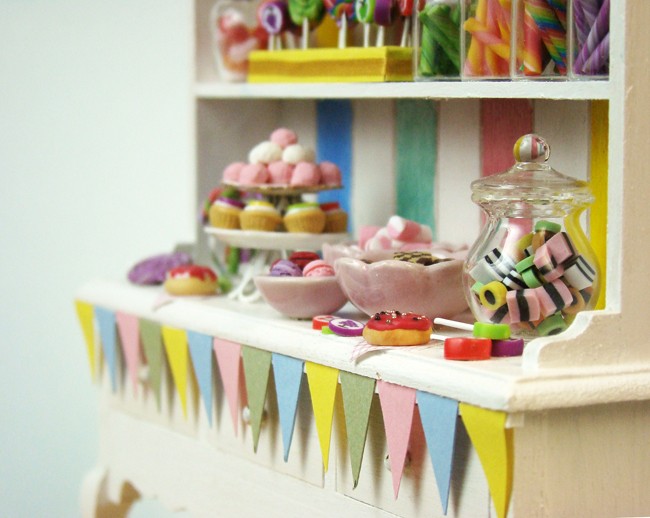
(photo, above, of a miniature clay candy cupboard, and all photos that follow are from PetitPlat)
Stéphanie loved "drawing houses as a kid and in the roof I always imagined a tiny private play park, with a swimming pool and many stairs which took you to different thematic rooms.
So the roof was a bulky potato on top of a normal house. Way cool."
1/24/2011
art & patience (part 4 in a series on the roots of design)
A few weeks ago, we began this series by asking artisans about the seeds of their inspiration and the roots of their design.
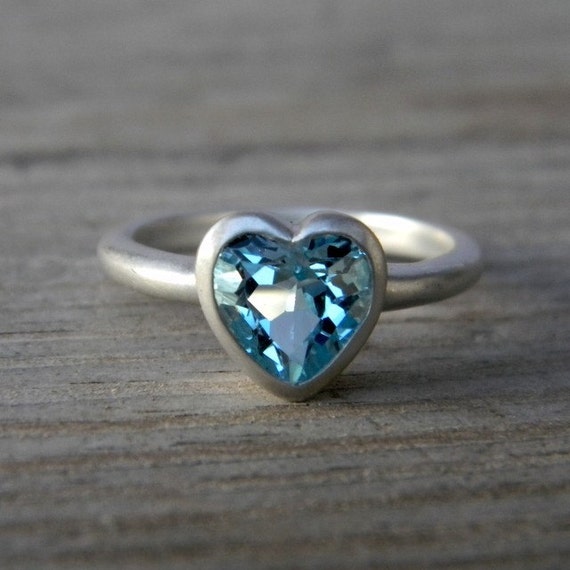
(photo above, of Monica's rustic silver heart necklace - all photos that follow are from moonovermaize as well)
In part 4 of the series, Monica from moonovermaize shares beautiful insight into her own creative path. And the patience required to find her way. I love this quote about patience by Edward Bulwer-Lytton: "Patience is not passive; on the contrary, it is active; it is concentrated strength." Indeed.
"For me, it was not a specific moment, but a conglomeration of artistic attempts gone wrong. I was always trying out different forms of art growing up from drawing to painting to sculpting to making mosaics and sewing. Seeing as my Mom is an incredible seamstress I thought it would come naturally....I was so wrong on that one!"
Monica is pretty sure she "tried nearly every art/craft under the sun and I was always left a bit disappointed as the final product never came out as I had envisioned it. It has never stopped me from searching though and then I tried out some metalsmith techniques about a year ago and I had finally found what I'd been searching for!"
"It felt right. My hands could manipulate the tools and supplies to form exactly what was in my mind. Now that I've found what I love it is a matter a perfecting techniques and allowing myself to grow in this line of work. Seeing as it took some patience to get to this point I believe it has also taught me patience in my art of metal work."
1/20/2011
first creative memories (part 3 in a series)
Thank you so much for sending in all of these beautiful stories and ancedotes of early artistic inspiration. This series will now go live with a new artist every Monday, and every Thursday.
(photo above, watercolor print by silverridgestudio - and all the photos that follow are from Cate as well)
You can see the first posts here:
• the seeds of creativity with Linda from PaperPhine
• roots of design with Daria from LaLaShoes
Today, we are treated to some of the first creative memories of Cate, the artist behind silverridgestudio, whose work was recently featured in Lucky Magazine. She says her current inspiration "comes from many places. Ealing Studios, French and Italian Cinema, along with music, theatre and dance." Thank you, Cate, for sharing with us what some of your earliest creative sparks were.
"My first memory of drawing was at my Grandparents. I was fascinated with an architecture book that belonged to my Granddad. I spent most weekends staying with them so I used to copy pictures of windows and doors for hours out of that book."
1/17/2011
roots of design
Today is part 2 of our ongoing "inspiration" series on this blog. A series where we look at what influenced artisans among us to become what we are today, what helped inspire us along our path of creativity.
(photo, above - all and all photos below - from LaLashoes here)
Daria, the artisan and industrial designer behind LaLaShoes, offers us a beautiful glimpse into what helped to shape her way of thinking and her approach to design and creativity. Thank you, Daria, for taking the time to share such a moving series of memories and insights with us. Your post really made me think and consider the contributions of those close to me. I'm sure it will do the same for many of our readers.
In Daria's own words:
"From my father and my maternal grandmother I learned the most valuable lesson regarding my creative life - 'What you want but can't have or afford, you can make yourself! And it's much more fun doing it yourself too!'"
"Actually, they never told me that directly, but I learned that from both of them when I was very young. My grandmother was always making clothes and dolls for us. I enjoyed spending time with her and learning to sew and knit. I also enjoyed all the stories she told me about how she made trendy woolen coats for my mother and her friends out of woolen blankets, and nobody ever found out (early '50 poverty!), and also all her dancing dresses and everyday clothes. Among other things, I learned to make doll dresses out of scraps or used garments, and to re-use the wool from sweaters I outgrew."
"My father was always making things. He used to do wonderful sketches every evening for all the things he wanted to make, solving the technical problems, dimensions, everything. There was always a big pile of books on his side of the living room table - mechanics, physics, the Technical Encyclopaedia volumes, books on architecture, Neufert's Ergonomics (that I eventually used myself at university)...
...He spent most of his free time in his workshop in the attic, making stuff out of anything - he would reuse all kinds of pipes, wooden pieces, tin metal sheets… you name it. There was basically nothing he would thought of that he couldn't make. He liked to make his own improved versions of tools too, or design tools that he needed but didn't exist yet."
From him - from my father - I learned to solve things logically, applying math and physics, searching for answers in books, to think through sketches, to recycle and reuse any kind of material to make what I wanted.
I don't remember him ever making a toy for me, but I think that's because he knew I was able to make my own - I was always hanging around in his workshop and asking for tools. My father would always answer my questions about how to make something better, or lead me through some basic technical problems, usually challenging me to make even better versions of my own designs. I learned a lot just watching him working. Dad also learned to sew as a child; I got my first sewing machine from him as a gift.
My dad made our house - from a blueprint, through a scaled model we still keep as memory, all the way up to the roof. He made also a special crane from an old ship motor engine to help him get the materials high, as the house was growing. If you can learn to design and make a house, the sky is the limit, right?
From all that, I really learned that there is nothing you can't do if you apply yourself, if you're willing to learn a lot and if you're creative. That's something I consider invaluable. Thank you nonna and dad for this wonderful gift!
1/10/2011
Inspiration: a new series about the seeds of creativity
As I watched my nearly-four-year old daughter paint her version of a world map recently (after having been engrossed in the atlas most of the week), I started thinking about how the seeds of creative thinking, and artistic expression are planted. How inspiration for future, artisanal work begins. Where. Who. How.
So I did what I usually do, and ask some of the artisans whose work I love, and am privileged to share with on the Artisans Gallery team.
(handmade wooden star wands, above, from ImaginationKids)
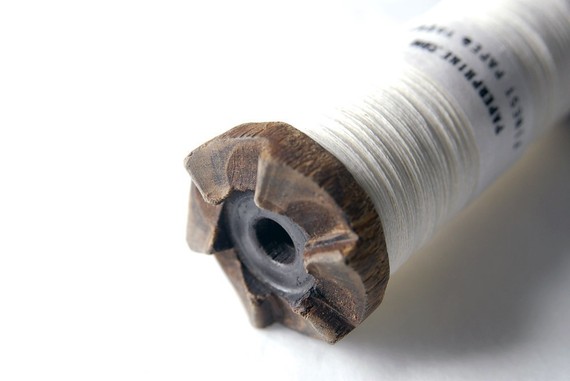
Today, I start off this new series with Linda, from PaperPhine.
"One my favourite things to delay bedtime as a kid was to get out one of the numerous craft books and start a project that would obviously not be finished by the time the grown-ups considered to be bedtime. Luckily, there were a lot of craft books and a seemingly endless supply of materials in my parents' house thanks to my Mum who was always working on something and still is nowadays. So these books were definitely a shaping influence early on and the older I got the more sophisticated the books got."

"When I was about 14 years old I bought the book Paper: Making, Decorating, Designing by Beata Thackeray and I was hooked. Setting up a paper making workshop in my parents' basement, kitchen supplies and gadgets started to disappear suddenly and sometimes turned up again covered with paper pulp and glue.
Anyway, I was hooked on paper, my library on the subject grew constantly and I did internships with European papermakers and paper artists. When I went to Art University I was quite disappointed that the staff teaching paper making had not really any in-depth knowledge on paper making and therefore I concentrated on the new fields that were to discover: diverse textile techniques and skills. When paper yarns appeared in my life thanks to a dear friend somehow everything fitted together nicely and became even more exciting.
Even nowadays books are extremly important for my work as inspiration and guides to new techniques and ideas. The library is forever growing and one day I'll probably need a whole room just to store my books in. Exhibitions and talks with fellow artisans and artists are probably equally important for my work but it's books that are a recurrent theme through my life and work."
(all photos, above, from PaperPhine's lovely shop)
11/22/2010
Creative Fire: Drive
photo by raceytay
My husband is reading a book that interests me: Drive: The Surprising Truth About What Motivates Us, written by Daniel Pink. Pink became well known for "A Whole New Mind," his 2005 best-selling book in which he made the bold statement that right-brainers -- people who are strong in qualities such as empathy, storytelling and inventiveness -- will rule the future. So, naturally, I like the way he thinks!
The introduction explains the meaning behind the title “Drive.” The first drive is biological. It is the most basic and primitive and includes the need for food, drink, shelter and basic survival. The second drive is more external; reward and punishment. This is where psychologists, managers and parents have spent most of their time. But then, when a group of monkeys started playing with puzzles with enjoyment and focus, scientists realized that there might be another drive in all of us. This third drive is focused on the pure joy of performing the task. Pink explores all the different ways that this third drive expresses itself and the results both people and organizations achieved when they opened themselves up to this third drive.
earrings by Markhed
I’ve been thinking long and hard about the case he makes that if you get stuck seeking short term rewards you can extinguish your internal motivation, ie, the joy of working. In his list of the flaws of short term rewards, Pink includes that they can crush creativity and that they can become addictive.
Selling is a short term reward on Etsy. Our number count goes up, we get a short feature on Pounce. There is a momentary high. Making the Front Page is a short term reward. Having one’s treasury make the Front Page is a short term reward. Each produces a feeling of accomplishment, of exhilaration. While I'm not leaping to the conclusion that we need 12 step support groups for treasury and front page addicts, I am asking myself if the joy of creating my pottery is still greater than the thrill of seeing the image of it on Etsy’s front page. I also monitor for myself how much custom order work, which is inherently less creative, is okay for me to take before the actual fun gets sucked out and replaced by my sales +1. Now that creative types are predicted to rule the future, I don’t want to miss my chance! I’ve started experimenting with new glazes in the middle of the holiday sales blitz just to keep my priorities straight.
ring by onegarnetgirl
Are you having fun today?
by Lee Wolfe/ OneClayBead
11/15/2010
Creative Fire: The Little Voice
For many years I worked as a production potter which means throwing 60 mugs in 1 hour; one per minute. It means silent repetition that commands complete attention. Production pottery is a fierce teacher and if your mind wanders, the rhythm is lost, the clay wobbles off center, the forms start to look tortured.
I had an apprentice once whose mind was very restless and never shut up. I could see his petty niggling thoughts in his forms and work habits. I had spoken to him for months about how he needed to still his mind if he wanted to be a potter.
I told him what all studio artisans must confront at some point: there is a little voice in your head. It evaluates, judges, and criticizes ceaselessly. It is full of negative self analysis when you are trying to create, and when you look up and outward at the world, it criticizes everything that you see out there, too.
Norman, my apprentice, first insisted that he didn’t hear a little voice. After weeks of prompting, he said that he heard it sometimes but that he was in control of it and could turn it off whenever he wanted. That particular day, he was having relationship problems, and had been complaining about his partner all morning. He noticed that his Little Voice couldn’t leave the subject alone.
Norman stepped outside “to clear his mind.” He came back in filled with excitement. “I heard my little voice!” he said, “I heard it say that the mountains are so beautiful. The trees especially green today. And then it said that the trees should be thinned a bit so that I could see better. I heard myself evaluating and criticizing the mountains, and you are right! It never shuts up!”
Norman began laughing, full out, silly, contagious laughing. I joined him. And in that moment came what we all truly crave.
Silence. Being in the flow. Happiness.
by Lee Wolfe/ OneClayBead
11/08/2010
Creative Fire: Rumi
The 13th Century poet and mystic Rumi has been a touchstone of mine for decades. My own blog The Beauty You Love is an ode to his famous line: Let the beauty you love be what you do.
Rumi uses words the way that I use clay. He takes me places that are peaceful, pure, and sometimes, only music or Rumi can soothe the places that ache. It won’t make sense. And maybe the lesson here is that what we really need is something that doesn’t make any sense at all.
Do not grieve for what is lost. Anything you lose comes round in another form.
Let yourself be silently drawn by the stronger pull of what you really love.
We are the mirror as well as the face in it.
We are tasting the taste this minute of eternity.
We are pain and what cures pain both.
We are the sweet cold water and the jar that pours.
I want to hold you close like a lute so we can cry out with loving.
You would rather throw stones at a mirror?
I am your mirror, and here are the stones.
When you do things from your soul, you feel a river moving in you, a joy.
………………………………………………………….
Click on any picture to find the artisan’s work.
Lee/OneClayBead
11/05/2010
The Art of Dabbling
I'm a dabbler. I have about one million different interests which I'm constantly trying to pursue simultaneously, with frequent trips to the public library and various lists of things to look up and in to.
I think many creative people are like this. I've come to find out that being an artist is really the opportunity to look into a little bit of everything---one day I'm looking up the origin of a certain word, the next day I'm making a study of cabbage. I love this aspect of a creative life.
"Art soul heart necklace" by lulubug jewelry
My most recent dabble is a foray into textile arts---a couple of weekends ago I decided to teach myself to crochet. I've had mixed results with trying to learn textile arts---I'm a draw-er, and so I love the instant gratification of putting pen to paper and often have trouble with crafts that take time to develop. But this time, I sat myself down and didn't get up until I had learned to crochet.
With this experience, I learned two things: one: I could actually learn to crochet---given adequate determination! And two: learning to crochet really flexed some muscles I hadn't used in a while---my brain hurt and my hand was sore, but I was high on the energy of having learned something completely new.
The more art I make, and the longer I'm in this game of being a maker, I realize that this is the key to sustaining a creative life: keep trying new things, whether you're in a creative career, or you're just seeking to live an adventurous life. As my experience with crocheting showed me---every new experience pushes your brain to think in new ways, and new ways of thinking is what creativity is all about. Creativity is the practice of bringing new things into being. In order to be able to do that, you have to always be seeking to see things in a new way.
This is where the dabbling spirit comes in---it seems to be a chicken and egg situation---does the dabbling spirit come from being creative, or does being creative come from dabbling? I think it's both.
Even the most creative person gets into ruts---perhaps you could even claim that it's the most outwardly successful creative people that are the most prone to ruts---the more you are recognized for your creativity, the easier it is to just keep doing what's working {financially speaking}.
But what's working now, will not sustain you creatively for the rest of your life. The creative spirit likes to fly and see new things. And to sustain it, you have to be always willing to keep following what's most exciting to you---you have to always remember to follow the wonder. With that idea, it seems that the real key to living a creative life over the long-term is to learn to dance with change. To be always open to where your creativity and dabbling takes you. To see life as one big adventurous dance of flight.
Where are you flying to today? What new things are you dabbling in?